
Last updated on May 29, 2026
Understanding Acne Scars Starts with Knowing Your Skin
Even after active breakouts have settled, acne can leave behind lasting changes in the skin. For some people, this means temporary dark marks or redness that gradually fade. For others, it can lead to deeper textural changes that affect how smooth and even the skin looks over time. These changes are often grouped together, but post-acne marks and true acne scars are not the same thing.
Understanding the different types of acne scars is the first step in choosing the right approach. Some scars affect the surface of the skin, while others create deeper changes in structure and contour. Knowing what type of scarring you are dealing with helps set realistic expectations and guides which treatment options may be most effective.
What Are Acne Scars?
Acne scars form when inflammation from breakouts damages the deeper layers of the skin during healing. When this happens, the body may produce too little or too much collagen, leading to either depressed scars or raised scars, depending on how the skin repairs itself.
This is different from post-inflammatory hyperpigmentation, which refers to flat dark marks or redness left behind after acne clears. These marks are not true scars and often improve with time, while structural acne scarring on the face tends to be longer-lasting and may require more targeted treatment.
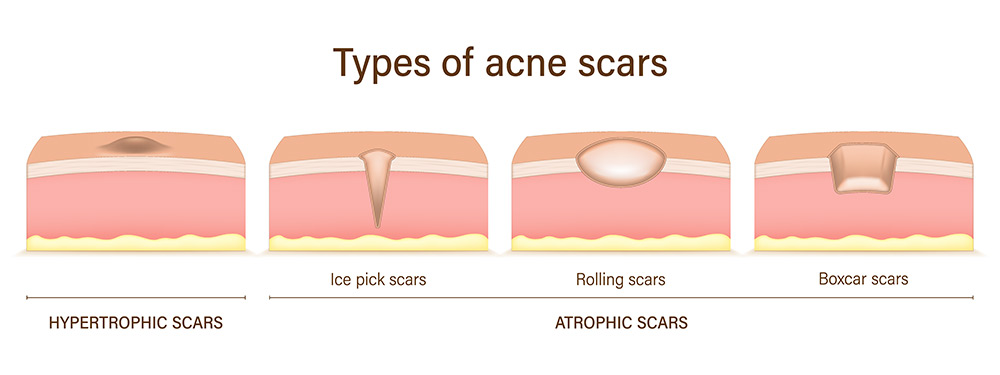
Different types of acne scars affect skin texture in different ways, which is why accurate diagnosis matters.
What Causes Acne Scars?
Acne scar causes are often linked to how severe the original breakout was and how the skin responded during healing. Deeper inflammation increases the risk of long-term textural change, particularly when breakouts affect the lower layers of the skin.
Common causes include:
- Inflammatory acne: Cystic acne, nodules and deep inflamed breakouts are far more likely to cause scarring than surface-level spots. The more inflammation present, the greater the chance of collagen damage during healing.
- Picking or squeezing spots: Squeezing active acne can increase trauma within the skin and make inflammation worse. This often increases the risk of pitted acne scars and uneven skin texture later on.
- Delayed or ineffective treatment: When active acne continues for a long period without proper management, repeated inflammation can increase the likelihood of permanent acne scarring and visible skin texture changes.
- Genetics and skin healing response: Some people naturally scar more easily than others. Genetics, skin type and individual healing response can all influence how likely acne is to leave long-term marks.
The Main Types of Acne Scars
Not all acne scars look the same, which is why identifying the scar type matters before considering acne scar treatment. Different scar patterns respond better to different treatment approaches, and many patients experience more than one type at the same time.
Ice Pick Scars
Ice pick acne scars are small, narrow and deep, often looking like tiny punctures in the skin. They usually extend further into the skin than they appear on the surface, which is why they can be difficult to treat. These scars are most commonly found on the cheeks and are often linked to severe inflammatory acne or cystic breakouts.
Boxcar Scars
Boxcar acne scars are wider depressions with sharper, more defined edges. They often create a sunken appearance in the skin and can vary in both depth and size. These scars are commonly seen on the cheeks and temples and tend to become more noticeable under direct lighting or makeup.
Rolling Scars
Rolling acne scars create a softer, wave-like texture across the skin rather than sharply defined pits. They form when bands of tissue pull the skin downward, creating shallow dips and uneven contour. This type of acne scar often gives the skin a less smooth appearance, particularly across larger facial areas.
Hypertrophic and Keloid Scars
Hypertrophic acne scars are raised scars caused by excess collagen during healing, while keloid scars are a more pronounced form where the scar tissue grows beyond the original breakout area. These scars are more common on the jawline, chest, shoulders and back rather than the central face.
Post-Inflammatory Hyperpigmentation
Although often confused with acne scars, post-inflammatory hyperpigmentation refers to flat dark marks or redness left behind after acne heals. These are pigment changes rather than true structural scars. Unlike pitted acne scars, they do not change the skin texture and often improve gradually with time.

Professional assessment helps identify acne scar types and creates a clearer plan for long-term skin improvement.
Can Acne Scars Go Away on Their Own?
Post-acne marks such as redness or pigmentation often improve naturally with time, especially when the skin is protected from further irritation and sun exposure. This is why some people notice visible fading months after breakouts settle.
True acne scars are different. Once the skin structure has changed, the scar usually does not disappear completely without treatment. While some improvement can happen naturally, deeper acne scar skin texture changes often need more targeted support for noticeable results.
Treatment Options for Different Types of Acne Scars
There is no single solution for acne scar removal because treatment depends on the type of acne scar, its depth and the overall condition of the skin. A personalised approach is usually more effective than trying to treat every scar in the same way.
Skin Resurfacing Approaches
Chemical peels and other resurfacing methods may help improve surface texture, support skin renewal and reduce the appearance of shallow scars and post-acne marks. These approaches are often used when the main concern is uneven tone, mild texture change or superficial acne scarring on the face.
Volume-Restoring Treatments
Some depressed scars benefit from restoring support beneath the skin, particularly where deeper contour changes create shadowing or visible unevenness. Improving volume in targeted areas can help soften the appearance of pitted acne scars and improve overall skin smoothness.
Combination Treatment Plans
Many patients have a mix of rolling acne scars, boxcar scars, pigmentation and uneven skin texture. In these cases, combining different treatment approaches often creates better overall improvement than relying on a single method alone, particularly when multiple scar types are present.
When to Seek Professional Advice
If acne scarring continues to affect skin texture long after breakouts have cleared, it may be worth seeking professional advice. This is especially true when pitted acne scars, raised scars or persistent unevenness start to affect confidence or become more noticeable in certain lighting and photographs.
Assessment helps separate temporary post-acne marks from true structural scarring and allows treatment expectations to be discussed realistically. Understanding the scar type first is often the most important step before deciding how to treat acne scars effectively.
Smoother Skin Starts with the Right Diagnosis
Treating acne scars successfully starts with knowing exactly what you are dealing with. Ice pick scars, rolling scars, boxcar scars and post-acne marks all behave differently, and the best results usually come from matching the right treatment to the right type of scar.
Rather than focusing only on quick fixes, a careful assessment of scar pattern, skin quality and long-term goals helps create a more realistic and effective plan. With the right guidance, clearer and smoother-looking skin becomes a much more achievable goal.
Ready to Take the Next Step?
If acne scarring continues to affect your skin texture or you are unsure whether you are dealing with post-acne marks or true acne scars, schedule a free initial phone consultation to discuss your concerns. A professional assessment can help identify the type of scarring and determine which treatment options may be most suitable for smoother, clearer-looking skin.
FAQs
What is the difference between acne marks and acne scars?
Acne marks are usually flat areas of redness or pigmentation left behind after a breakout heals, while acne scars involve a permanent change in the skin’s texture or structure. Marks often fade naturally over time, but true acne scars, such as pitted or raised scars, usually need more targeted treatment.
Are acne scars permanent?
Some post-acne marks improve gradually on their own, but true structural acne scars are often longer lasting. Once collagen damage has changed the surface of the skin, noticeable improvement usually requires treatment designed for that specific scar type.
Do chemical peels help acne scars?
Chemical peels may help improve certain types of acne scarring, particularly shallow texture changes and post-inflammatory pigmentation. They are less effective for deeper pitted acne scars, such as ice pick scars, where more targeted treatment may be needed.
How do I know what type of acne scar I have?
Looking at whether the concern affects skin colour, texture, or both can help identify the scar type. Deep, narrow pits often suggest ice pick scars, wider depressions may indicate boxcar scars, and soft, uneven texture is more common with rolling scars. A professional assessment can help confirm this more accurately.
Which acne scars are hardest to treat?
Ice pick acne scars are often considered one of the more difficult types to treat because they are narrow but extend deeper into the skin. Treatment usually depends on scar depth, skin quality and whether multiple acne scar types are present at the same time.

About The Author
Mr Mrinal Supriya
Mr Mrinal Supriya is the Divisional Director of Surgery. He is highly experienced Head and Neck Surgeon, specialising in facial cosmetic surgery. He is the clinical director for head and neck service in Northamptonshire and works as an ENT Consultant. He is the lead head and neck robotic surgeon at the University hospital of Northamptonshire (2023). Previously, he held the post of ENT, Head and Neck consultant at St.George’s University Hospital, London and at Ninewells University Hospital, Dundee.



 Online Marketing For Doctors